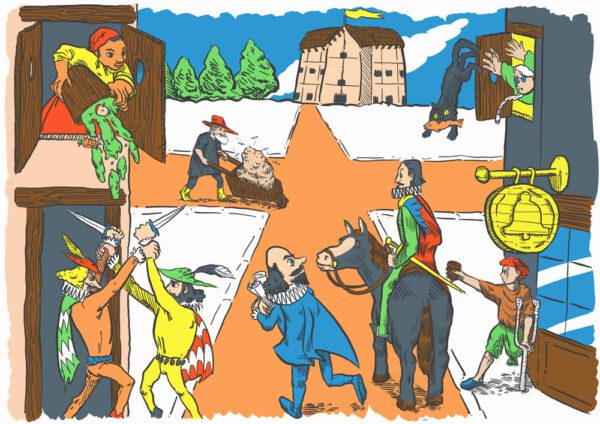
Illustration: David Surman.
In this four-week course, we consider the theatre of Shakespeare’s time from four unique perspectives: the people making the theatre, the people writing plays for it, the people acting and watching it and the characters brought to life onstage.
Email ABitLitContact@gmail.com to book.
Delivery: The course will be delivered by a series of 4 video lectures, posted to YouTube and accessed by private link. Participants will be offered an additional Q&A online session each week, and sent a reading list. Links and details will be sent out to participants a few days before the course begins.
Week One: Theatremakers
Who first built theatres, and why? How did they run them?
Week Two: Writers
What does it mean to write for the brand new space of the early modern playhouse? How did playhouses change the way writers worked?
Week Three: Actors and Audiences
What did it mean to attend the live event of the theatre? How did both actors and audiences respond to being in these spaces, encountering these stories?
Week Four: Characters
What kind of characters filled the early modern playhouse? How aware are they of being in a theatre, and how do they explore the world around them?
Further Info
For questions about the course, or to book, please contact us at abitlitcontact@gmail.com. Links and details will be sent out to participants a few days before the course begins.
Course Leaders
Andy Kesson
The course will be delivered by Andy Kesson, author of John Lyly and Early Modern Authorship, editor of a special issue of Shakespeare Studies on early English drama, and co-editor, with Emma Smith, of The Elizabethan Top Ten: Defining Print Popularity in Earlly Modern England. Andy led the Before Shakespeare research project, and is part of the Box Office Bears research project.